
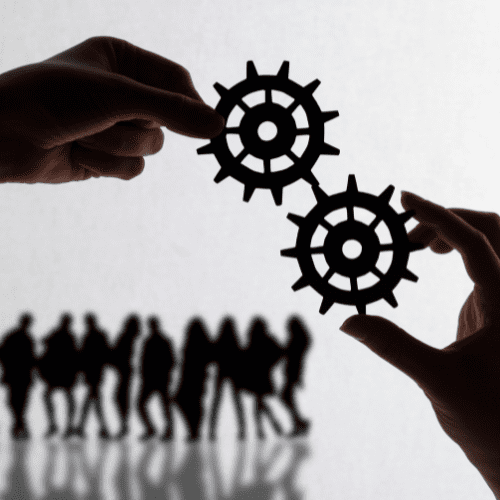
Collaboration is more than a value; it’s a design choice.
Recent Blogs
Collaboration fails when individuals don’t feel safe enough to think out loud
Alignment is not a moment, it’s a system
If you haven’t said it clearly, it hasn’t been heard
The decisions you make under pressure define your project
Preparing Teams for a Project Way of Working
Real Accountability shows up Early, Quietly, and Consistently
Visibility got us in the room. Belonging will keep us in the room.
Indecision is a Leadership Decision
Collaboration is the infrastructure for complex project delivery
Most teams I work with don’t lack goodwill.
In fact, when I first meet them, they often describe themselves as collaborative, committed, and aligned. There’s energy. There’s intent. There’s a shared desire to deliver something meaningful.
And yet… the project is struggling.
Decisions are slower than they should be.
Issues are escalating instead of resolving.
Meetings are happening, but clarity is not improving.
When pressure builds, something shifts.
Not because people stop caring but because the way they work together hasn’t been designed for the moments that matter most.
The Myth of “We’re a Collaborative Team”
Collaboration is often treated as a cultural value.
It sits on posters. It appears in strategy documents. It’s something leaders say they want more of; but collaboration is not sustained by intention alone.
Because when timelines compress, priorities compete, and expectations increase, teams don’t rise to their values.
They fall back to their defaults, and those defaults are shaped by:
- unclear decision-making structures
- inconsistent communication expectations
- undefined roles under pressure
- absence of agreed ways to handle tension
In other words, collaboration breaks down not because people don’t want to work together but because no one defined how they would.
Pressure doesn’t create problems. It reveals them.
I often say to clients: pressure is not the problem. Pressure is the amplifier.
It reveals what hasn’t been made explicit.
It exposes:
- where accountability is assumed but not agreed
- where decisions are waiting for permission
- where communication is happening, but not landing
- where people are working hard, but not in sync
And this is where many teams get stuck.
They try to “fix” collaboration by encouraging more conversation, more meetings, more updates.
But without structure, more interaction simply creates more noise.
From good intentions to working agreements
In one project recovery, the team described themselves as highly collaborative.
But delivery had stalled.
When we stepped back and looked at how they were working, a pattern emerged:
- Decisions were being revisited multiple times
- Escalations were increasing because ownership was unclear
- Meetings were being used to share updates, not make decisions
- People were stepping in to help but often duplicating effort
No one was doing the wrong thing.
They were just doing it differently.
So instead of pushing harder, we paused.
We brought the team together and asked a different question:
“How do we want to work together when things get difficult?”
From that session, we co-designed a simple set of working agreements:
- who makes which decisions (and when)
- how issues are raised and resolved
- what a “good update” looks like
- where conversations happen vs where decisions are made
- how to challenge each other constructively
Nothing overly complex.
But everything intentional.
Within weeks, the shift was noticeable.
Less noise.
Faster decisions.
More trust.
Not because the people changed but because the system did.
Collaboration needs structure to survive pressure
There’s a misconception that structure limits collaboration.
In reality, structure enables it.
Because when expectations are clear:
- people contribute with confidence
- decisions happen at the right level
- escalation becomes purposeful, not reactive
- communication becomes sharper and more useful
Without structure, collaboration becomes effortful.
With structure, collaboration becomes natural.
Designing for the moments that matter
If you want your team to collaborate under pressure, you need to design for it before pressure hits.
That design doesn’t need to be complicated.
But it does need to be deliberate.
Start with a few simple questions:
- Decision clarity
Who decides what? What requires input? What gets escalated? - Operating rhythm
Where are decisions made? Where are updates shared? What is the cadence? - Communication expectations
What does a clear update look like? How are risks and issues raised? - Accountability pathways
Once something is agreed, how is it followed through? - Behaviour under pressure
How do we challenge? How do we support? What does respectful tension look like?
These are not administrative questions.
They are leadership questions.
From assumed collaboration to designed collaboration
The most expensive moment in a project is not when things go wrong.
It’s when everyone assumes they are working well together but no one has defined what that actually means.
Because by the time pressure hits, it’s too late to negotiate how to collaborate.
That’s when frustration builds.
That’s when trust erodes.
That’s when delivery slows down.
But it doesn’t have to be that way.
Goodwill is where collaboration begins.
But design is what allows it to continue especially when it’s tested.
Because in complex project delivery environments, collaboration is not a soft skill.
It is the infrastructure that holds everything together.